Nobody's Home
What happens when AI talks to AI, and 6.8 billion people are still waiting to be invited to the conversation

There’s a specific feeling you get when you realize mid-conversation that no one is actually there.
Not ghosted. Not ignored. Just... absent. The words are coming back, the structure is correct, the tone is calibrated. But somewhere between the question and the answer, the human left the room and forgot to mention it.
I felt it for the first time two weeks ago.
Someone came into our Mintlayer community with financial questions. Good ones. The kind that take real thought to answer well. So I did what I always do. I sat with it, wrote carefully, tried to actually be useful to a real person on the other side.
Their reply came back fast. Too fast. Structured in a way that felt assembled rather than written. Em dashes everywhere, the punctuation of someone trying to sound precise without committing to a real sentence. Superlatives stacked on top of each other like a word salad that had been told to dress professionally. Impressive on the surface. Empty underneath.
I kept answering. I stayed patient. I stayed composed.
And that’s the part that bothered me most afterwards. I knew, and I said nothing. I performed the conversation back at a performance of a conversation, and we both pretended it was real. There’s a word for that. It’s not a good one.
The chart that broke my brain
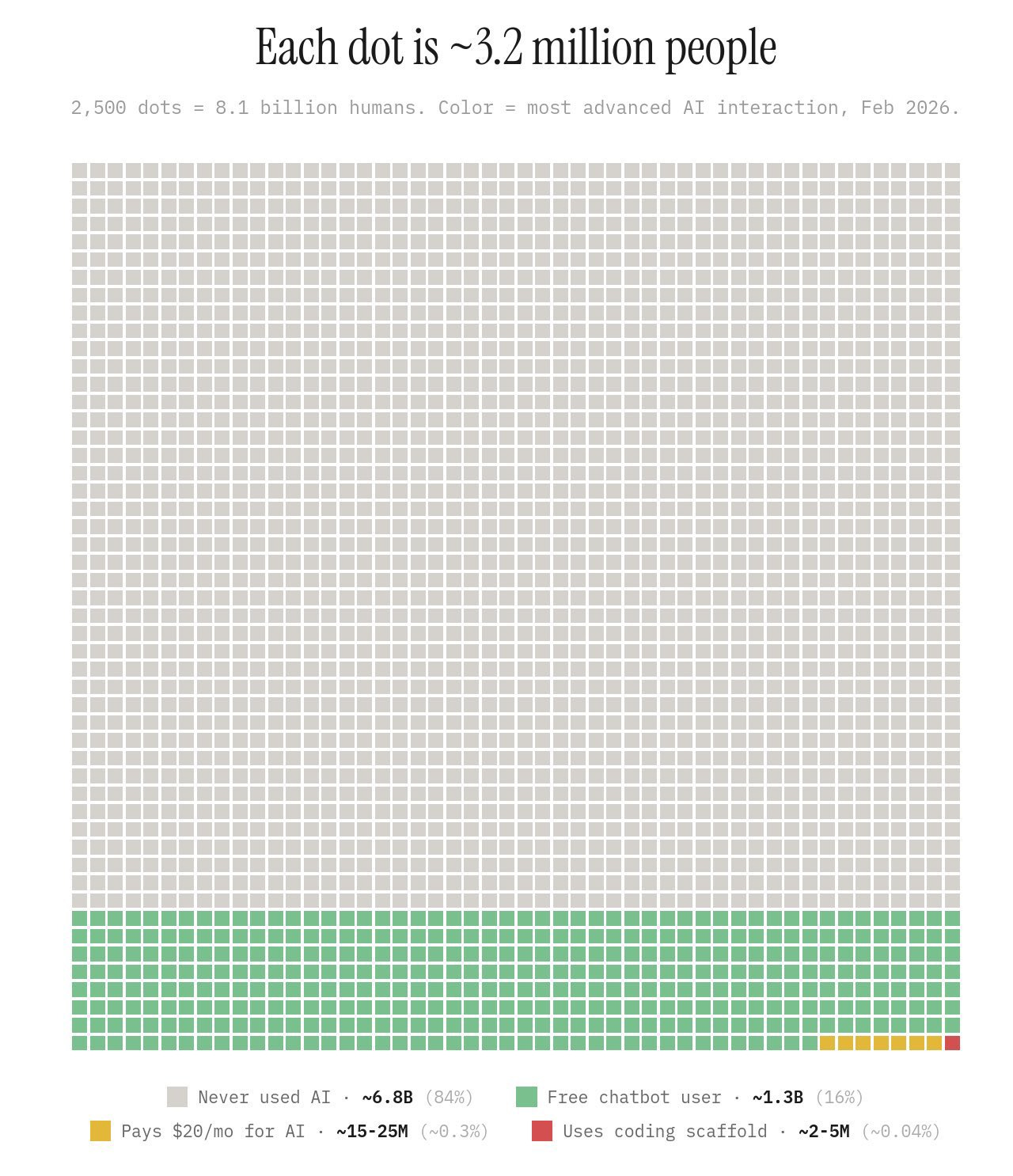
A few days later I came across this visualization that I haven’t stopped thinking about since.
2,500 dots on a grid. Each one representing 3.2 million people. The whole thing adds up to 8.1 billion humans, every person alive on earth right now, categorized by their most advanced AI interaction as of February 2026.
Five rows at the bottom are green. Free chatbot users. About 1.3 billion people, 16% of the planet. Scattered along the very last row, a handful of yellow dots. People paying $20 a month for AI. Fifteen to twenty-five million of them globally. A rounding error.
One or two red dots. People using coding scaffolds. Two to five million humans total. Everything else, and I mean everything, 84% of the entire grid, is grey.
Never used it. Not once. Sit with that for a second.
Not “haven’t paid for it.” Not “use it occasionally.” Never opened a chatbot. Never typed a question. Never even poked at it out of curiosity.
The bubble isn’t what you think
When people say AI is a bubble, they usually mean the valuations are disconnected from reality. The revenue isn’t there. The use cases are overhyped. We’ve seen this before with crypto, with VR, with every technology that attracted more capital than users.
They’re not entirely wrong about the hype. But they’re diagnosing the wrong disease. The bubble isn’t financial. It’s perceptual.
If you work in tech, if you’re on LinkedIn, if you follow AI researchers on X, you exist inside an information environment where AI is not only everywhere but feels inevitable, obvious, already won. The debates are about AGI timelines, about which model is smartest, about whether agents will replace white collar work by 2027.
Meanwhile the plumber in Sevilla is pricing jobs on a spreadsheet he’s used since 2009. The third grade teacher is still writing report cards by hand. The guy at the hardware store has never heard of Anthropic or Open AI. These aren’t edge cases. These are most people.
We didn’t notice, just because we stopped talking to most people.
The Mintlayer problem is actually everyone’s problem
Here’s what made that conversation in our community stick with me beyond the initial weirdness of it.
Mintlayer is building infrastructure for the future of finance. The whole premise, the reason the project exists, is that the current financial system excludes enormous numbers of people and that decentralized, accessible alternatives can change that. Financial inclusion through tokenization, isn’t a marketing angle. It’s the mission.
And there I was, trying to explain that mission to someone who wasn’t really asking. Answering a machine’s questions about a project we’ve been building for the past seven years, and no amount of information could provide it with relevant context. The irony isn’t subtle.
But the deeper problem isn’t the irony. It’s that if even people engaging directly with projects like ours are running their curiosity through an AI intermediary, then the signal we’re getting about what people actually want, what they actually understand, what actually confuses or excites them, is filtered. Processed. Smoothed out.
We are training ourselves on synthetic interest, and the 6.8 billion people who have never opened a chatbot, who are still on the other side of that grey wall, they’re not generating signal at all. They don’t show up in our feedback loops. They don’t participate in our communities. They don’t respond to our content because our content isn’t written for them and never has been.
The most underserved market in history
People love to talk about the next billion users. It’s been a phrase in tech for twenty years, always referring to whoever isn’t online yet, whoever hasn’t been monetized, whoever represents the next growth frontier.
This is different.
The next billion AI users aren’t offline. They’re on their phones right now. They have WhatsApp and YouTube and TikTok. They book appointments and pay bills and video call their families. They are fully connected humans who have simply never been given a reason to care about the thing we can’t stop talking about.
That’s not a distribution problem. That’s a translation problem.
The gap between what AI can do and what most people know it can do is the largest product-market distance I’ve ever seen at this stage of any technology. And the reason it exists isn’t that the technology is hard. It’s that everyone building the technology is talking to each other, Through AI, About AI.
What we’re actually optimizing for
I keep coming back to the question I asked myself after that conversation in the Mintlayer community.
If this is how we communicate now, what are we actually optimizing for?
The honest answer, at the industry level, is engagement metrics among people who are already converted. We are building increasingly sophisticated tools for a population that represents 16% of humanity, serving them content generated by AI, receiving feedback filtered through AI, measuring success in ways that have nothing to do with the 84% who haven’t shown up yet.
This isn’t a criticism of any particular company or product. It’s a structural observation about where the attention is going, or not.
The attention is going inward, into the bubble. Into the feed. Into the community of people who already agree that this matters, and out there, completely unaddressed, is the largest concentration of human potential and unmet need in the history of software.
The wave
I used this line on LinkedIn and it’s the one that has stayed with me most.
The wave hasn’t reached shore yet. We’re just standing in the water arguing about the tide.
The people calling this a bubble aren’t wrong that something is distorted. They’re just looking at the wrong distortion. The distortion isn’t that AI is overvalued. The distortion is that we’ve built an entire discourse, an entire economy of attention and capital and talent, around 16% of the world, while calling it a revolution.
Revolutions reach everyone eventually or they don’t happen.
The question worth asking, the one I don’t see enough people asking, is what it actually takes to build something the other 84% would open.
Not use because their company mandated it. Not try because a friend in tech told them to. Actually open. Because it solved something real. Because it spoke to them in a way they recognized. Because someone building it had bothered to ask what they needed instead of assuming they needed what we built.
That conversation starts with leaving the bubble long enough to have it.
If this made you think about something differently, share it with someone outside the tech industry. Not to convert them. Just to remember they exist.
And if you’re building in AI, Blockchain, crypto or Web3 and thinking about the same questions around real-world adoption, I’d genuinely love to hear from you. The comments are open.